‘Terra Incognita’: Tracing Literary Occult Pathways in North London

North London has quite a gothic pedigree. From Bram Stoker’s Lucy Westenra stalking Hampstead Heath to Stephen King’s terrifying Crouch End ‘Towen’, an otherworldly atmosphere lingers here. The region has captured the imagination of writers through the ages, casting the area as both friend and foe.
21st-Century Victoriana: Our love letter to the dark
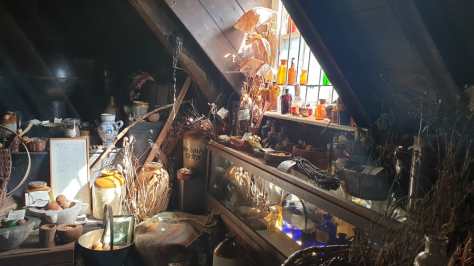
We humans would rather have something a bit flawed but true than gloss-plastic perfection. On the surface, that doesn’t seem to be so—with ‘reality’ TV shows illustrating a life that’s nothing like reality and Instagram influencers filtered into poreless automatonica—but there is an undercurrent backlash to this that I see all around us. Our collective psyche is seeking to balance itself: enter Victoriana.
London’s Buried Rivers: The Hackney Brook in Stoke Newington & Other Ghosts from London Below

https://www.flickr.com/photos/jondoe_264/4943108993/in/photolist-8wNJ68-8nTKDr-bJz85x-6b6kuh-bJzdNa-eTKhXV-eTKj94-22WYgpu
The 13 rivers and brooks of London still flow. Once they passed through fields and valleys, and now they run along pipes and sewers. But they have survived through the human world. They are buried, but they are not forgotten. (Ackroyd, 2011, 38)
The vision of London’s rivers flowing in the open air is of a time long past. These rivers today flow in darkness. They are as hidden from our view as the past from which they came. It’s this ability that they hold to be of the past—yet also, undeniably, here and now—that positions the river as a conceptual access point to conceive of the temporal shifts within hidden layers of place.
Lord of the Dead, Fairy Cavalcade, Psychopomp: The Mysterious Origins of the Wild Hunt & Its Many Faces in Popular Culture
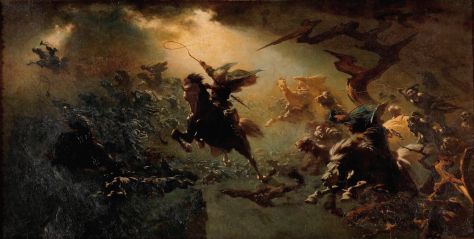
Wild Hunt traditions are extremely various and widespread, involving a complex overlay of Celtic and Saxon sources, of pagan and Christian beliefs, of national myth and local legend. Looking at different author’s treatments of the Wild Hunt we can see not only the variety of its origins, but also its potential to be evoked in different forms and for different fictional purposes. Some Wild Hunts are savage, amoral, and intensely powerful, embodying the irresistible force of nature itself. In his function as a Lord of the Dead, the leader of the Wild Hunt is the embodiment of living wildness. Accompanied by his consort (as he sometimes is) the fertility goddess, they represent the two sides of life and death, they are the complete cycle of renewal.
Blackthorn: Dark Mother of the Woods, Crone of the Triple Goddess, Witch Wood

‘The blackthorn full of spines—but how the child delights in its fruit.’
— ‘Cad Goddeu’, 14th-century Welsh poem
The blackthorn tree fascinates because of its inherent duality. On one hand, a folkloric symbol for strength, overcoming adversity, purification, and protection, it is also considered a trickster, bad luck if crossed, and easily used as a weapon in the wrong hands. Blackthorn has, perhaps, the most sinister reputation in Celtic tree lore.
Pirates, Smugglers, Treason & a Fake King: The Scandalous History of Lundy Island

Pirates, smugglers, treason, and a fake king—Lundy Island has seen it all. Something about this enticingly close, yet seductively remote, little island has attracted ne’er-do-wells for over 1,000 years…
Clockwork Sky: Astrology in Early Modern & Victorian England
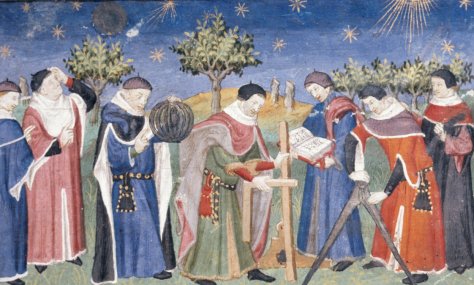
Comets, importing change of times and states,
Brandish your crystal tresses in the sky.
— William Shakespeare, (Henry VI, Part 1, Act 1, Scene 1)
Seeking answers in the heavens has a history as old as humankind itself. Every culture across our planet shares a heritage of calculating and making sense of the wondrous universe that surrounds us by studying the clockwork of the night sky. This is England’s story.
Here Be Monsters: Sailor Stories & Nautical Folklore

‘The widow-making, unchilding, unfathering deep.’
—Gerard Manley Hopkins (1844-1899)
It has been said that no group of workingmen harbour as many superstitions within its collective breast as sailors do—and well this should be, because no body of workers endures such dangerous conditions of employment as those mariners who ply the seven seas to make their living. In this piece, I’ve gathered just a few pearls from the deep. Here you’ll find some interesting superstitions, legends of beasties and ghost ships—ending with one full-length tale of pirate horror.
If you’d like to enjoy an audio walk through Tower Hamlets Cemetery in London—or just enjoy a sea legend from the comfort of your couch—my audio walk ‘Siren Sea—All is Lost for She’ is a tale of lost love and a sea siren.
Of Churches & Liquor: Green Man, Jack-in-the-Green & the Revels of May
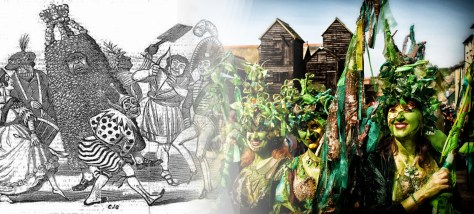
How is the Green Man linked to the Jack-in-the Green? When was green—instead of red—the colour of lust? And what does any of this have to do with church carvings and pubs? Come with me on a journey through May celebrations of yesteryear.
As we ready ourselves for a rather unique May bank holiday weekend this year, I thought I’d explore the celebrations of Mays long past, to share the curious revels of long ago while we wait for our time for celebrations to come again. The good ol’ Jack-in-the-Green seemed a good place to start. I thought I’d uncover a rather straightforward history of this fellow. However his story—I’m delighted to say—is not straightforward at all.
An Outlaw Hero for Every Age: The Enduring Legend of Robin Hood

Robin Hood was first the subject of epic legends under different names before becoming a character of country festivals and the Tudor stage. Georgian literature then elevated him to the status of national hero. From bawdy street performance to ecological festivals today, Robin Hood is an outlaw hero for every age.
Springtime Renewals: Drinking to the Vernal Equinox

The vernal equinox is almost upon us. A time to hail the arrival of spring and to wake up our bodies and minds from a long winter’s cosy. This seasonal flux might feel a bit odd this year. We’re all welcoming the coming of spring from our stay-inside lockdowns, but we can create a feeling of renewal by brightening up our homes and cleansing our bodies to best prepare for the times ahead.
Now—while a good spring cleaning is surely a wonderful thing for the spirit, when it comes to how I’ll embrace the season, I’d rather play with herbs in the kitchen than bust out a mop, so here’s my contribution to the Vernal Equinox: beverages!
Woodland Magick: Modern Animism & the Folkloresque
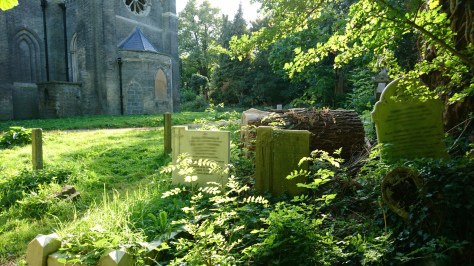
In this post, I’ll share with you some of the investigations into the scientific basis for animistic folklore that I explored for my PhD thesis, which resulted in my two nature audio walks through Abney Park cemetery: Woodland Magick and Woodland Networks.
I cannot avoid the conclusion that all matter is composed of intelligent atoms and that life and mind are merely synonyms for the aggregation of atomic intelligence.
– Thomas Edison, 1903
As a metaphysical monism, animism is based upon the idea that nature’s essence is minded.
– Emma Restall Orr, 2012
I wrote my PhD thesis on the layered heritage of Abney Park cemetery in the north London community of Stoke Newington. My thesis was practice-based, which means my method of inquiry was based on a project, in my case audio walks through the cemetery. For those of you who aren’t familiar with Abney Park, it’s a Victorian garden cemetery that once held such vibrant plant diversity that it rivalled Kew Gardens. Today, it’s rather rewilded and overgrown, and many of the species once cultivated there are lost to time, however the 32-acre grounds of Abney Park are still an important ecological feature within the borough of Hackney. It is a registered Metropolitan SINC (Site of Interest for Nature Conservation).
 Blackthorn & Stone