Here is a little video I’ve made explaining a bit of what my project is about. I’m now almost two months into my research journey! I will be presenting my preliminary findings at the Bridges 2022 conference, ‘Bridges Between Disciplines: Gender in STEM and Social Sciences’, at the Universitat Politécnica de València – Campus of Gandía. I’m excited to share what I have learned so far!
“I fancy he may be something of a misogynist.” — Beatrix Potter, in her journal December 1896, about Mr Thiselton-Dyer Director, Kew
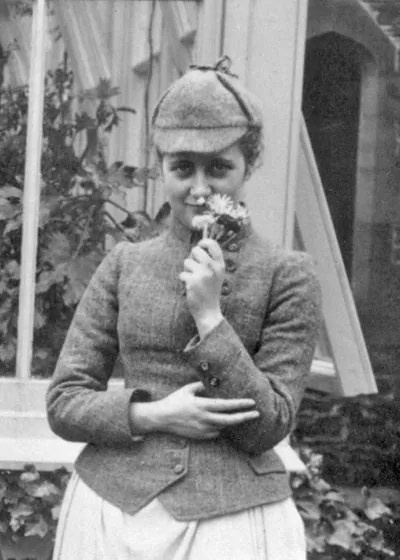
Several years before Miss Helen Beatrix Potter (1866-1943) became the beloved children’s author whom we all treasure, creating the world of Peter Rabbit and Mrs Tiggy-Winkle, she had much smaller lifeforms on her mind: fungi. And there was a man (or rather, several men) standing in her way to mycorrhizal greatness. One of whom was no less of a personage than William Turner Thiselton-Dyer, Director of the Royal Botanic Gardens, Kew.
It all began with her illustrations. She was a very talented artist, in both sketch and watercolour, but alongside this ability she also had the gift of very close observation. Beatrix sketched and painted a variety of fungi that she found in the Lake District in England and in Scotland. As her documentation became more detailed, she began to be fascinated by how fungi reproduced. By the autumn and winter of 1895, when she was 29 years old, she was spending an increasing amount of time drawing fungi under a microscope. She became convinced that she could germinate some spores herself. She wanted to study the environment in which they germinated, discover whether or not conditions were the same for each species, what the spawn of each consisted of, and whether or not she could reproduce it more than once. This is where her hobby graduated from observation to experimentation.
Ah, the archive… That reliquary of truth and unbiased historical fact.
This week’s ‘fun fact’ is one of those research moments when another researcher points out a solution to your problem that actually should have been obvious from the beginning: if you’re looking for hidden histories, do not look at ‘official’ records, such as those kept by licensing guilds or at published works, nope. Look at court documents. Fines, punishments, incarcerations—executions. That is where you are going to find the true stories of what historical people—who were not White Christian Men (WCM)—were actually up to.
Throughout history, using legend and lore, we have sought to understand this night-time adventure. Witches have been condemned as the conjurers of nightmare sleep paralysis and faeries blamed for time loss or sleep-walking; we convince ourselves that ghostly spirits visit us at night with messages of hope or portents of danger.
The Nightmare by Henry Fuseli, 1781
In this illustrated lecture, Dr Romany Reagan will explore the creatures and meanings that fill our dreamscapes, from mediaeval British horrors to 19th-century curiosities and theories—and how these nocturnal happenings can play out in our waking lives.
Dr. Romany Reagan is an Arts Council England-funded research fellow with Museum of the Home, studying the hidden histories of women in Science, Technology, Engineering and Mathematics, from mediaeval cunning women and herbal witchcraft to 19th-century feminist botany. Her research has explored the layers of heritage within Abney Park cemetery and an occult literary heritage of London’s Stoke Newington area, as well as ‘earth mystery’, psychogeography and folklore, legends and lore from the British Isles.
This event is part of the Museum of the Home’s Festival of Sleep, running from June through September 2022.
This week’s ‘fun fact’ has to do with one of my favourite research subjects—witches. Research into the history of women in medicine will inevitably lead us back to the witch hunts. (And yes, there will be ongoing research into this particular flavour of persecution still to come… )






 Blackthorn & Stone