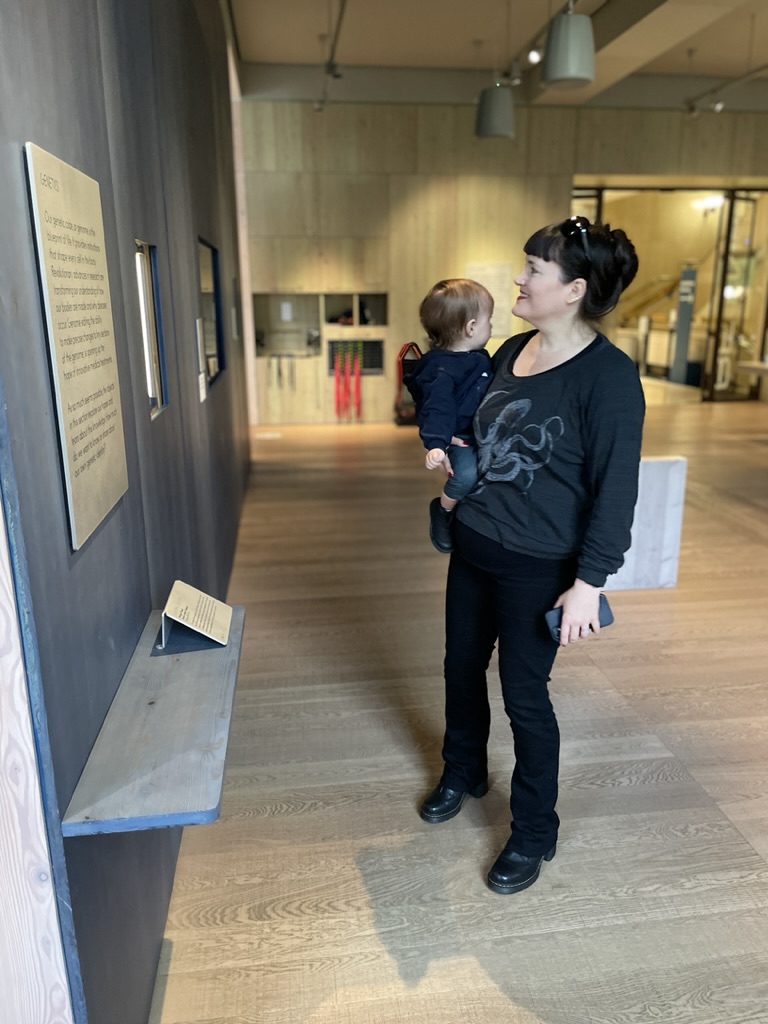
This new exhibition explores the protective practices and beliefs around pregnancy, childbirth, and infertility that existed in mediaeval times and continue through to today. However, my interest in going was to see the star of the show—an actual surviving mediaeval pregnancy protection scroll.
Mediaeval European women had freedom to act as healers and contributed substantially to all aspects of healthcare that were later denied to them in the Early Modern era. They were trained, and practised, as surgeons, empirics, anatomists, and barber-surgeons. Healing in mediaeval times consisted of a large grey area of what we would now consider mystical practices alongside practical remedies. The methods used by village healers and midwives, of healing through spells and potions, made them vulnerable to attacks from the emerging medical profession, the State, and the Church.
The Church itself had been involved in healing since Christianity began and were engaged in a form of magical healing of their own: the transubstantiation of the Mass, magical cures through holy water, and the power of relics of saints.
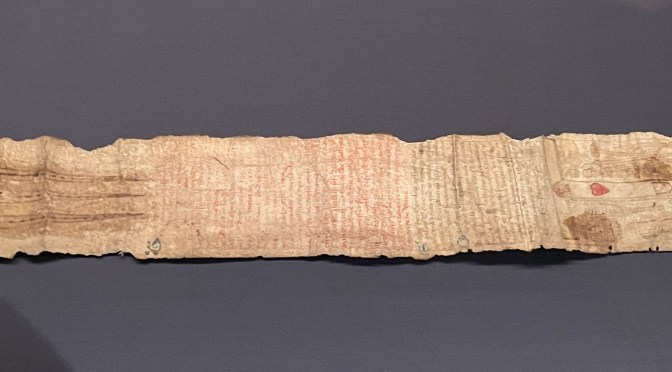
Although women could not be priests because of their gender, throughout the Middle Ages, women had been praised for healing through the supernatural. Female saints were appealed to for help and the tradition was continued into the Early Modern period. During labour, certain saints would be called upon with the help of objects and a sacred scroll (like this precious scroll featured here that I actually got to see in person!!) that could be laid on the belly of the pregnant woman to ease her labour and assure safe delivery of a healthy baby and a live mother.
After the Protestant Reformation, things changed for the village healer and midwife. Religious totems that were previously part of the common kit of a Catholic midwife suddenly became problematic and these items were taken away from midwives as now heretical. Studies have shown that there was a spike in women dying in childbirth right after the Reformation.
This isn’t to say that a sacred scroll saved the lives of women and babies directly, but their profound belief in the sacred scrolls and other Catholic icons did. Giving birth is as much a psychological exercise as a physical exercise. The anxiety these women were plunged into because of a governmental decision made far away from their village and day-to-day lives is heartbreaking to consider. If a pregnant mother believed with all her soul that a scroll would safely get her and her baby through childbirth—to take it away would cast the expectant mother into panic, which greatly raises her danger in childbirth.
Birth scroll with prayers and invocations to Saints Quiricus and Julitta, 1500CE
(Full images of the scroll and its attending descriptions below, all research pertaining specifically to these highlighted sections of the scroll undertaken and presented by the Wellcome Collection.)
The Three Nails: This is a depiction of the three nails used during Christ’s crucifixion, a common focus for prayer and meditation in mediaeval culture.
Protection from danger: This red text in Middle English promises protection against a number of dangerous situations in exchange for looking at or carrying the image of the cross below. Protection is offered against wicked spirits, thunder and lightning, battle, drowning, fire, plague or epidemic disease, and—as is important here—childbirth.
Arma Christi image: This is an image of the Arma Christi, the instruments used during Christ’s crucifixion, which included a spear, a sword, a ladder, a knotted whip, a hammer, and dice. Texts and images of the Arma Christi were very popular in mediaeval England as a focus for prayer and as a way to ask for divine assistance.
Performance & interaction: This section lists the names of God, interspersed with red crosses. Some of the names include; ‘tetragramaton’ (the four-letter Hebrew name of God, YHWH; ‘alpha et oo’ (Alpha and Omega, the beginning and the end); ‘agnus’ (the Lamb); and ‘ego sum’ (‘I am’). These are followed by the names of other holy figures, like the Magi, archangels (Michael, Gabriel, and Raphael), and various saints (Mary, Anne, Katherine, Margaret, Dorothy, and Barbara). At each cross, the reader would perform their devotion physically by making the sign of the cross with their hands.
Counting as meditation: This stylised image of Christ’s side wound, with it’s cascading blood droplets, sits between two texts about the wounds. The English text gives a specific number of blood droplets (547,500 in total), encouraging the reader to meditate on both text and image, using counting as a devotional and calming technique.
Illegibility & damage: The benefits of this scroll were unlocked through physical interaction (wearing or carrying the manuscript, and touching or kissing its images and text), which wore away a lot of the ink, leaving sections completely unreadable. Every time the manuscript is unrolled, more pigment flakes off and there is more risk of damage.
Stitching: Mediaeval manuscripts were often made from parchment, which is treated animal skin. This scroll, made from sheepskin, was constructed by sewing together long strips of parchment to create its 3-metre length.
Reverse side
Action & activation: Written in two lines along the length of the scroll, this text is similar to one on the front side of the manuscript. Both promise protection from various dangers. This one instructs the reader to recite a set number of prayers to activate the scroll’s benefits.
‘Gyrde thys mesure a bowte hyr wombe’: This instruction was directed to ‘a woman travailing (labouring) with child’. This is why scrolls like this are sometimes called ‘birth girdles’.
Stains: The torn edges and stained sections are a result of heavy use. Scientific analysis has shown these stains come from honey, egg, cereals, milk, and legumes, which were all used in mediaeval medical remedies. Traces of cervico-vaginal fluid were also found.


 Blackthorn & Stone